Last updated: Mar 2026
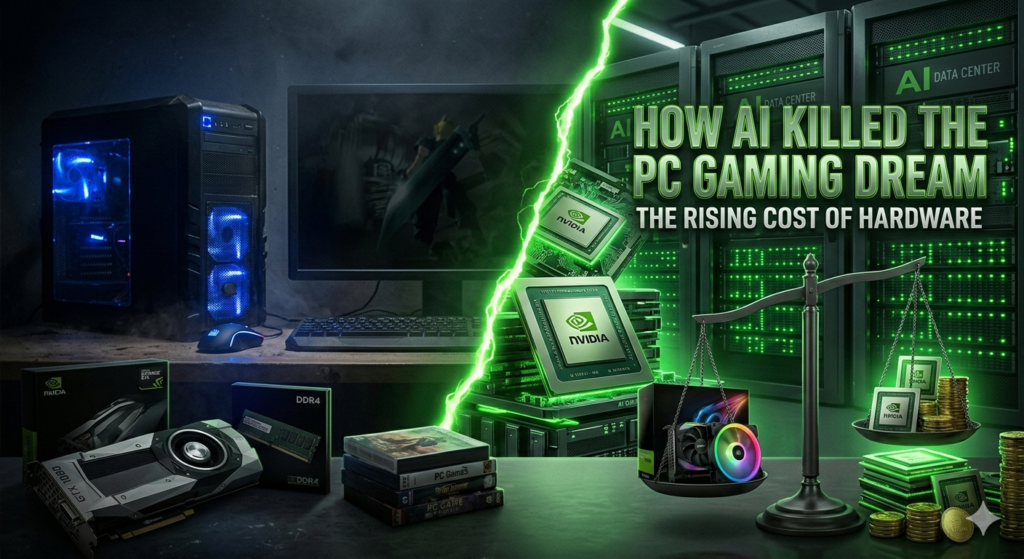
For decades, the “PC Master Race” was built on a simple, democratic promise: for the price of a mid-range television, you could assemble a machine that outperformed any console, offered infinite customization, and served as a gateway to digital literacy. Today, that dream is on life support. While performance has reached heights we couldn’t have imagined ten years ago, the barrier to entry has shifted from “accessible hobby” to “luxury investment.”
The culprit isn’t just inflation or supply chain lingering effects. The primary driver behind the skyrocketing prices of PC components is the global explosion of Artificial Intelligence (AI).
The GPU Gold Rush: From Pixels to Parameters
The Graphics Processing Unit (GPU) has always been the heart of a gaming rig. In the early 2010s, a flagship card like the GTX 980 Ti launched at around $650. Today, high-end cards frequently exceed $1,600. Why? Because the silicon used to render the beautiful landscapes of Elden Ring is the exact same silicon needed to train Large Language Models (LLMs) like GPT-4.
AI companies have deeper pockets than teenagers or hobbyist gamers. When a tech giant needs 30,000 H100 or RTX 4090-class chips to build a data center, they are willing to pay a premium that a consumer simply cannot match. This creates a “trickle-up” effect on pricing:
- Production Priority: Manufacturers like NVIDIA and TSMC (the foundry that makes the chips) prioritize high-margin AI enterprise silicon over consumer gaming chips.
- Scarcity Pricing: When supply is diverted to the enterprise sector, consumer availability drops, allowing retailers to keep prices artificially high.
- The “VRAM” Tax: AI development requires massive amounts of Video RAM (VRAM). To prevent enterprise customers from buying cheaper “gaming” cards, manufacturers often limit VRAM on mid-range consumer cards, forcing enthusiasts to pay for “Ultra” tiers just to get decent textures and longevity.
The Architecture Shift: Silicon Real Estate
Modern GPUs are no longer just built for gaming. If you look at the die of a modern RTX card, a significant portion of the silicon is dedicated to Tensor Cores. These are specialized hardware units designed specifically for deep learning and AI matrix multiplications.
While gamers benefit from this through technologies like DLSS (Deep Learning Super Sampling), we are essentially paying for AI hardware we didn’t necessarily ask for. We are subsidizing the research and development of AI through our gaming hardware purchases. The “silicon real estate” that used to go toward raw rasterization (pure gaming power) is now shared with AI processing, making the chips larger, more complex, and significantly more expensive to manufacture.
The Power and Cooling Crisis
AI-intensive chips run hot and hungry. To keep up with the demands of AI processing, modern components have seen their Total Board Power (TBP) soar. It is not uncommon for a high-end GPU to pull 450W or more.
This creates a secondary financial burden for the PC builder:
- PSU Requirements: You can no longer rely on a 500W power supply. High-end builds now require 850W to 1000W units with ATX 3.0 standards.
- Thermal Solutions: Massive heatsinks and liquid cooling loops are no longer optional “flexes”; they are requirements to prevent thermal throttling. This adds another $150–$300 to the total build cost.
Memory and Storage: The Silent Price Hikes
It isn’t just the GPU. The AI boom has put immense pressure on HBM (High Bandwidth Memory) and DDR5 RAM. As data centers hoard memory modules to handle the massive datasets required for AI training, the global supply of high-speed memory fluctuates, keeping prices for 32GB or 64GB kits higher than they would be in a gaming-only market.
Similarly, the demand for fast NVMe storage has spiked. AI models need to move data at lightning speeds, and as enterprise demand for Gen5 SSDs increases, the “gamer” versions of these drives remain at enthusiast price points, further bloating the budget of a “mid-range” PC.
Is the Budget PC Dead?
The most tragic casualty of the AI revolution is the $500 Budget King. A few years ago, you could build a very capable 1080p gaming machine for that price. Today, $500 barely covers a mid-range GPU and a decent power supply.
The industry has pivoted. Companies have realized that the real money is in B2B (Business to Business) AI infrastructure, not in selling cards to people who play League of Legends. This has left the entry-level market hollowed out, pushing many would-be PC gamers toward consoles like the PlayStation 5 or Xbox Series X, which provide better value through subsidized hardware.
The Silver Lining: Can AI Save What It Killed?
Paradoxically, AI might be the only thing keeping PC gaming playable on “cheaper” hardware. Technologies like DLSS, FSR, and XeSS use AI to upscale lower-resolution images, allowing a weak GPU to mimic the performance of a powerful one.
However, this feels like a “bandage” solution. We are using AI software to fix the performance issues caused by the fact that AI hardware has made powerful GPUs unaffordable.
Conclusion: A Luxury Future
The PC gaming dream isn’t dead, but it has changed. It is no longer the “everyman’s” platform. It has become a boutique, luxury hobby where the entry fee is dictated by the silicon demands of Silicon Valley’s AI arms race. To get back to the days of affordable gaming, we need a shift in manufacturing capacity or a cooling of the AI hype—but for now, your next “level up” will likely cost you more than ever before.
Written By GGNoPay Team