Last updated: Mar 2026
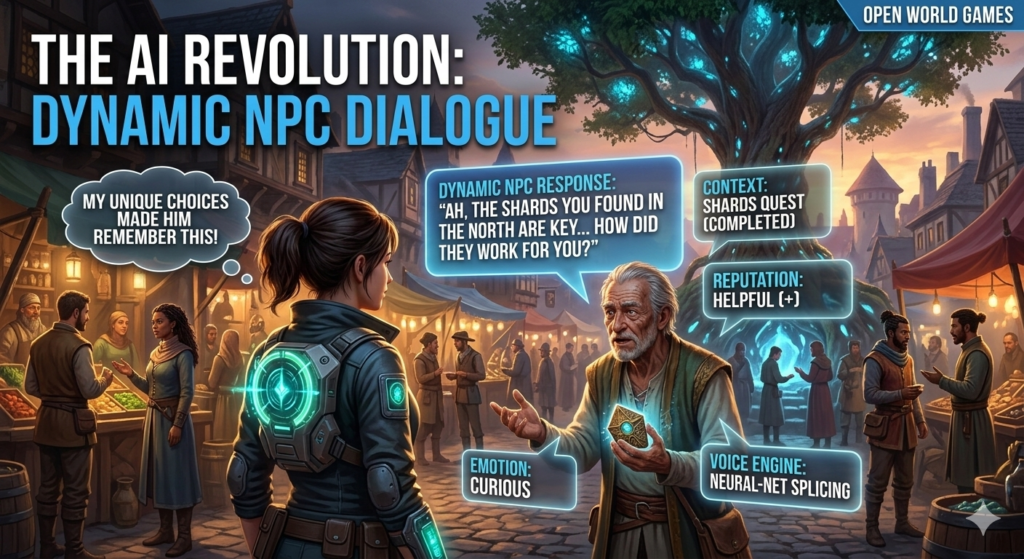
For decades, the standard open-world experience has relied on a beautiful illusion. Players explore massive, meticulously crafted environments like Los Santos, Night City, or The Lands Between, only to be pulled from the immersion by a non-playable character (NPC) who simply repeats, “I’ve seen some things…”
These “pre-scripted” interactions have long been a bottleneck for truly immersive gameplay. In 2026, however, a profound technological shift is occurring. We are moving away from the era of static, branching dialogue trees toward dynamic, Generative AI NPCs that redefine what it means to live inside a digital world.
Here is an in-depth exploration of how AI is fundamentally changing NPC interactions in open-world games.
1. The Death of the Scripted Tree: Dynamic Dialogue
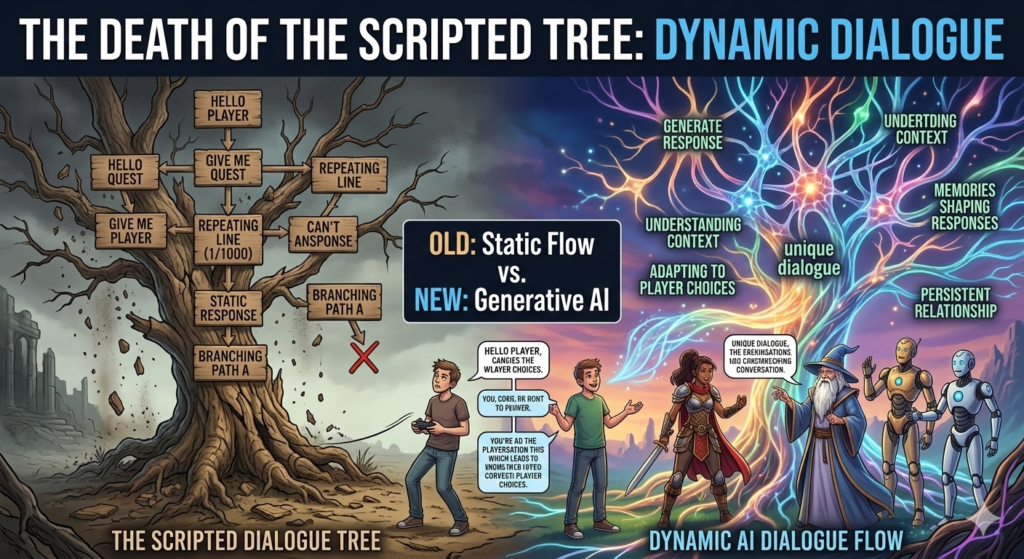
Understanding the Old Way
Traditionally, writers at studios like Rockstar or CD Projekt Red spent years scripting thousands of potential lines of dialogue. When a player approached an NPC, the game would select a response based on a rigid set of criteria (e.g., Is the player holding a gun? Has the player finished Quest A?).
This limited the scope of interaction. It felt passive, not active. The NPC was simply a narrative vending machine.
The New Generative Era
In 2026, many open-world developers are integrating Large Language Models (LLMs) directly into the game engine’s logic, a technology pioneered by groups like Nvidia (with ACE) and smaller middleware firms.
When you speak or type a query to a dynamic AI NPC, the request is not routed through a static file. Instead, it is processed through a neural network that understands context. The NPC generates a unique, contextually appropriate, and voiced response in near real-time.
- Impact: No two interactions are the same. A shopkeeper in a Skyrim successor might offer a discount not because it’s scripted, but because you previously saved their brother in a completely organic, unscripted emergency event on the other side of the map.
2. Advanced Environmental Context and Reactivity
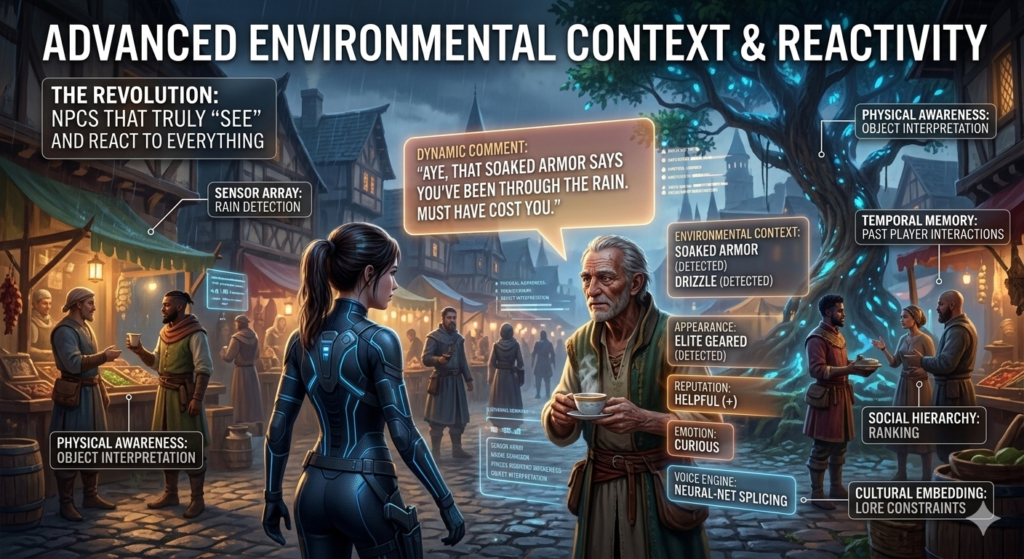
AI NPCs are no longer just passive dialogue bots; they are active agents aware of their surrounding context. In 2026, “reactivity” is the key metric for open-world immersion.
NPC Situational Awareness
Modern AI systems allow an NPC to constantly “see” and interpret the world. An LLM integration isn’t just about text; it includes the physical parameters of the scene.
If you approach an dynamic NPC, they might comment on:
- The Weather: “You look soaked; get out of this rain.”
- Your Appearance: “That’s a fancy piece of armor, friend. Must have cost you.”
- Your Past Actions: The system can track an “reputation context” that shifts dynamically. If you were aggressive in the last town, NPCs in this town might already be weary, adjusting their LLM personality parameter (e.g., from ‘Friendly’ to ‘Cautious’).
Emerging Heist Dynamics
Imagine a bank robbery in an upcoming GTA or Payday-style open world. With old technology, the hostages always react the same way. In 2026, dynamic AI enables contextual hostage negotiation. If you drop your weapon, one hostage might attempt to reason with you dynamically, while another uses an LLM-processed “fear factor” to trigger an emergent heart attack (or a quiet escape attempt) that shifts the mission’s complexity on the fly.
3. Persistent Memory: NPC Relationships That Evolve
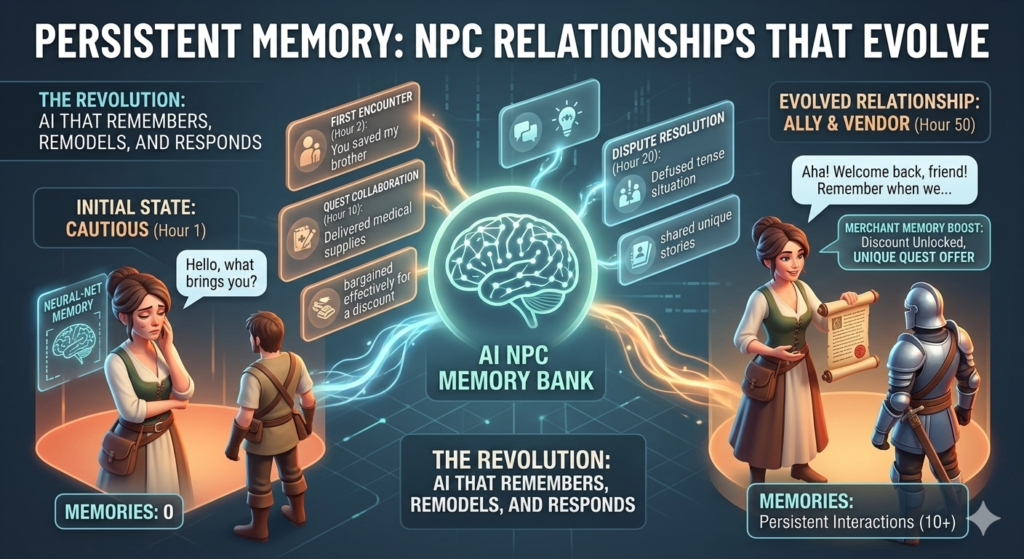
The most powerful advancement is long-term memory. This moves beyond a simple ‘like/dislike’ gauge. AI NPCs in 2026 can synthesize the results of previous interactions to build an emergent relationship context.
A dynamic vendor will remember:
- Every time you have bargained and whether it worked.
- The stories you told them.
- How polite you are.
Building Actual Alliances
This memory creates dynamic quest opportunities. In a game that uses persistent AI agents, a small NPC you treated well during a side mission in hour 2 might dynamically choose to appear and assist you during a major scripted story battle in hour 50, citing the old relationship. It feels earned, not mandated.
Conversely, making an enemy means making a persistent threat. They won’t just attack you on sight; they might dynamically spread rumors, making it harder for you to find work or safe harbor in other parts of the map.
4. Challenges: Performance, Logic, and Ethical Guardrails
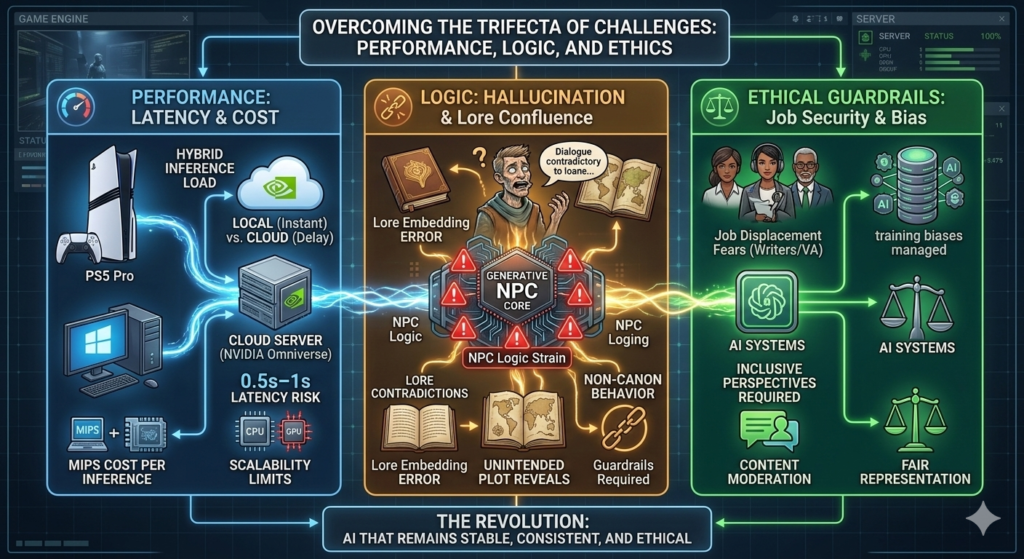
Despite the immense promise, the widespread adoption of AI NPCs faces significant technical and design challenges that studios are wrestling with in 2026.
The “Latency and Cost” Problem
Running real-time LLM inferences for hundreds of NPCs simultaneously requires a massive amount of computational power. Many games split the load, using a “hybrid model”:
- Local Inference: A smaller, specialized AI model runs locally on the user’s hardware (PS5 Pro/PC) to handle simple, instantaneous reactivity (environmental comments).
- Cloud Inference: More complex interactions require sending the context to a server (like Nvidia Omniverse) for a full generative dialogue response, creating a 0.5–1 second delay.
The “Hallucination” and Logic Problem
AI models can “hallucinate” information, creating a significant narrative risk. In an open-world RPG, you need the AI to stay within the lore. If a dynamic NPC generates dialogue that contradicts the core story or reveals later plot points too early, it breaks the game.
Developers use strict “guardrails” and specialized “lore embeddings” (feeding the AI a strict bible of the world’s history and rules) to constrain its generative output.
Ethical Concerns: Job Displacement and Inclusivity
The shift to generative AI has caused intense debate within the industry regarding job security for human writers and voice actors. While AI can generate thousands of unique interactions, industry leaders emphasize that human writers are still essential for crafting the core story and tone. Furthermore, training biases in models must be aggressively managed to ensure dynamic NPCs offer inclusive and diverse perspectives, rather than reinforcing harmful stereotypes.
Conclusion: The Future of Living Digital Worlds
The integration of Generative AI into NPC interactions is not a trend; it is the definitive next step for open-world games. In 2026, we are witnessing the emergence of worlds that don’t just feel large, but feel truly alive.
The illusion of choice is being replaced by the mechanics of genuine, persistent influence. The open-world games of tomorrow will no longer contain NPCs waiting to be spoken to, but AI agents actively navigating, remembering, and reacting to the player’s presence in a way that creates a unique narrative for every single gamer.
Written By GGNoPay Team